
The constant acceleration equations are four formulas linking velocity, acceleration, time and displacement. Knowing which one to use is enough to solve most kinematics problems in high-school physics (grade 10 in Vietnam). This guide summarizes the equations, the sign of acceleration, how to read a velocity–time graph and three worked problems.
What is uniformly accelerated motion?
It is motion in a straight line with constant acceleration: the velocity changes by equal amounts in equal time intervals. If the speed increases, the motion is uniformly accelerated; if it decreases, it is uniformly decelerated. Free fall is a special case with v₀ = 0 and a = g; see free fall formulas.
The four constant acceleration equations
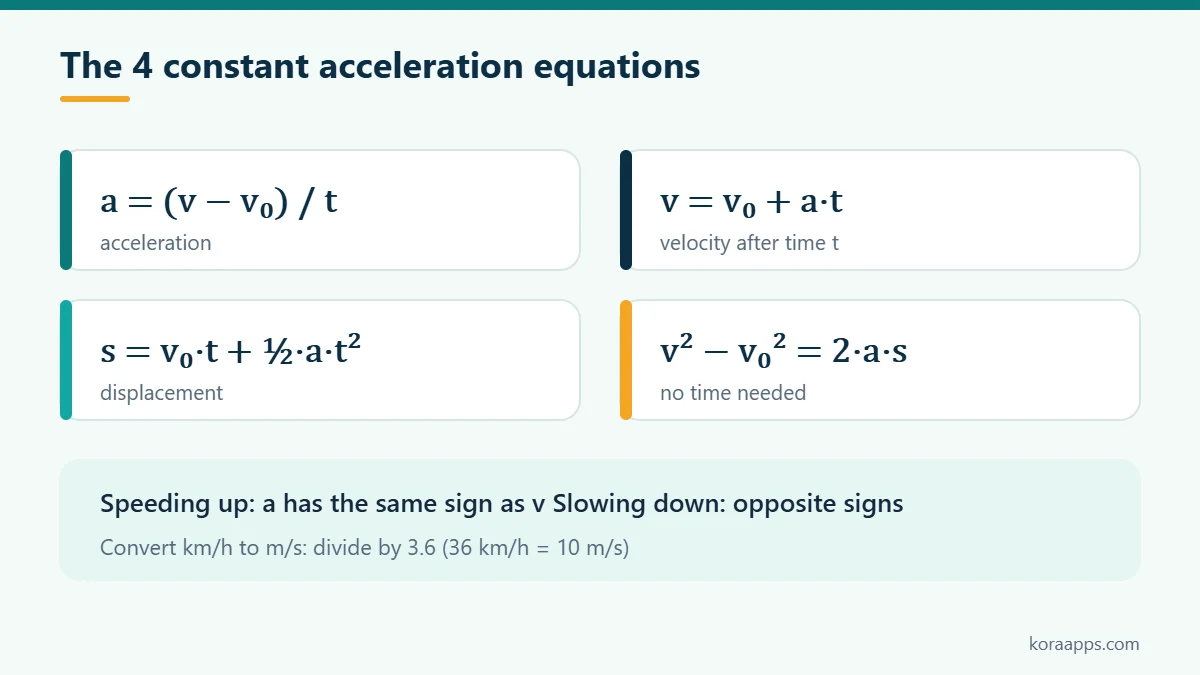
| Equation | Use it to | Does not need |
|---|---|---|
| a = (v − v₀) / t | Find acceleration from two velocities | displacement s |
| v = v₀ + a·t | Find velocity after time t | displacement s |
| s = v₀·t + ½·a·t² | Find displacement when time is known | final velocity v |
| v² − v₀² = 2·a·s | Link velocity and displacement | time t |
Quick tip: see which quantity the problem does not mention, and pick the equation that does not contain it.
The sign of acceleration
Take the direction of motion as positive. Then speeding up gives a > 0 and slowing down gives a < 0. The general rule: the object speeds up when a and v have the same sign, and slows down when they have opposite signs. Forgetting the minus sign of acceleration when braking is the most common mistake in these problems.
The velocity–time graph
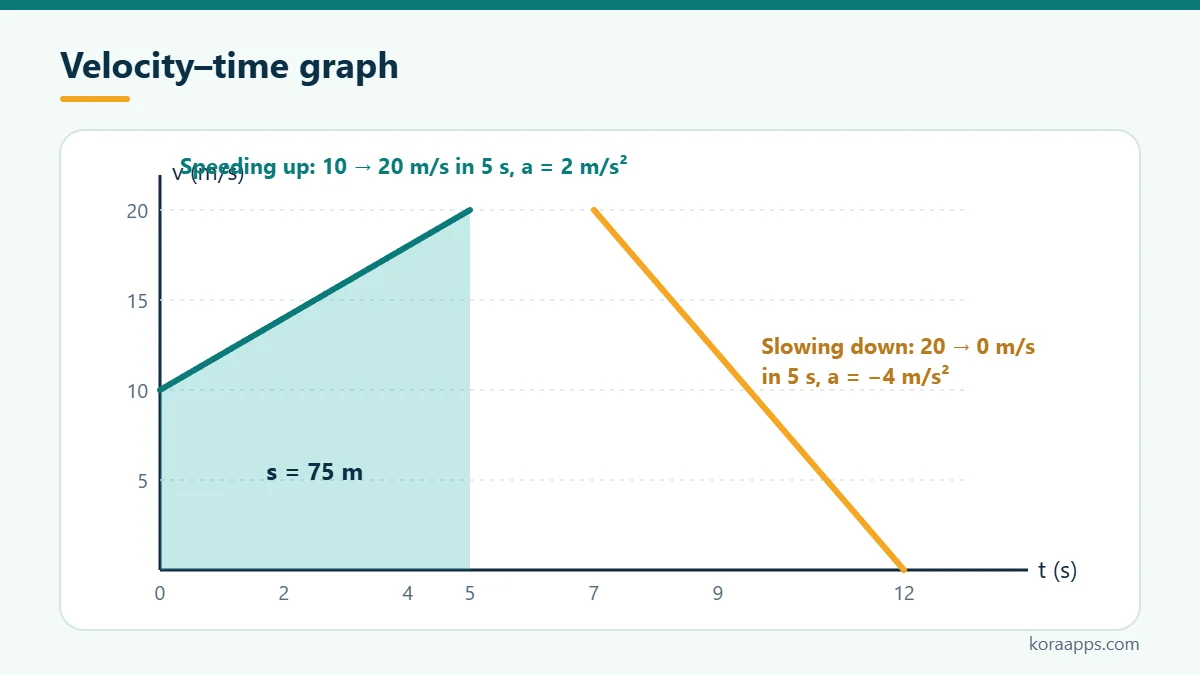
For constant acceleration, the v–t graph is a straight line. Its slope is the acceleration, and the area between the line and the time axis equals the displacement. In the example shown, velocity rises from 10 to 20 m/s in 5 s, so the trapezoid area is (10 + 20) / 2 × 5 = 75 m.
Worked problems
Problem 1: a car speeding up
A car traveling at 36 km/h accelerates uniformly at a = 2 m/s² for 5 s. Find its final velocity and the distance covered.
- Convert v₀ = 36 / 3.6 = 10 m/s.
- v = 10 + 2 × 5 = 20 m/s.
- s = 10 × 5 + ½ × 2 × 5² = 50 + 25 = 75 m. Check: 20² − 10² = 300 = 2 × 2 × 75.
Problem 2: braking
A car traveling at 72 km/h brakes with a deceleration of 4 m/s². Find the time and distance until it stops.
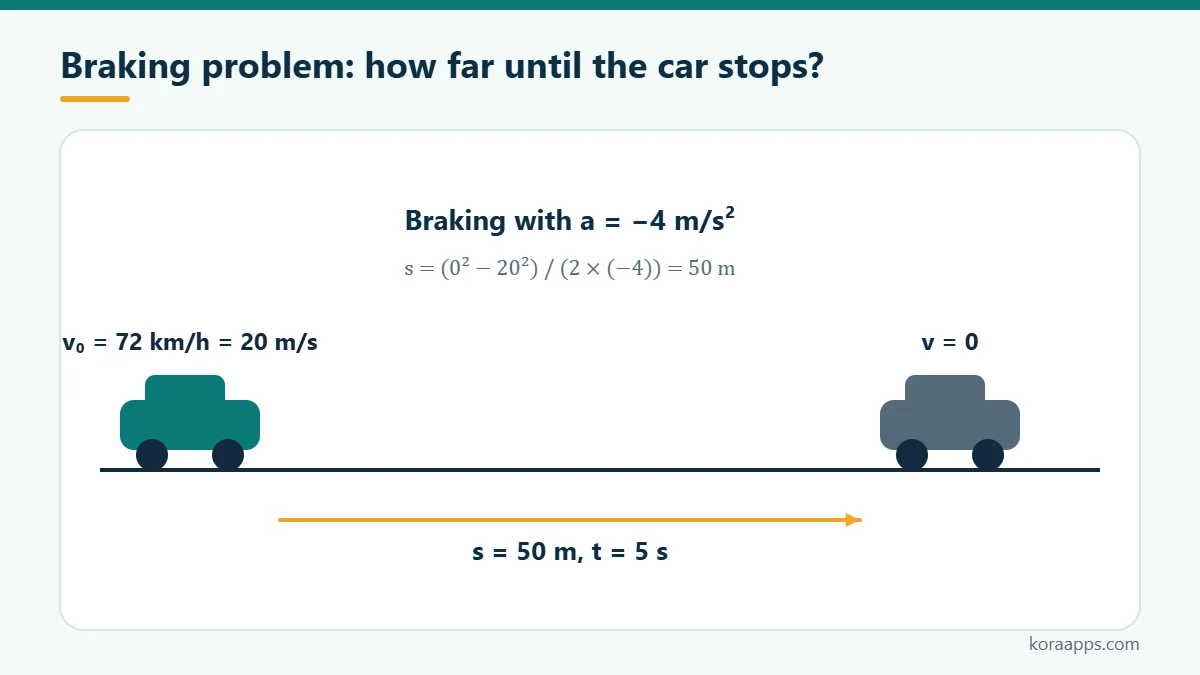
- v₀ = 72 / 3.6 = 20 m/s, v = 0, a = −4 m/s².
- t = (0 − 20) / (−4) = 5 s.
- s = (0² − 20²) / (2 × (−4)) = 50 m.
Problem 3: a train leaving the station
A train starts from rest and reaches 15 m/s after 10 s. Find its acceleration and the distance covered in those 10 s.
- a = (15 − 0) / 10 = 1.5 m/s².
- s = ½ × 1.5 × 10² = 75 m.
Common mistakes
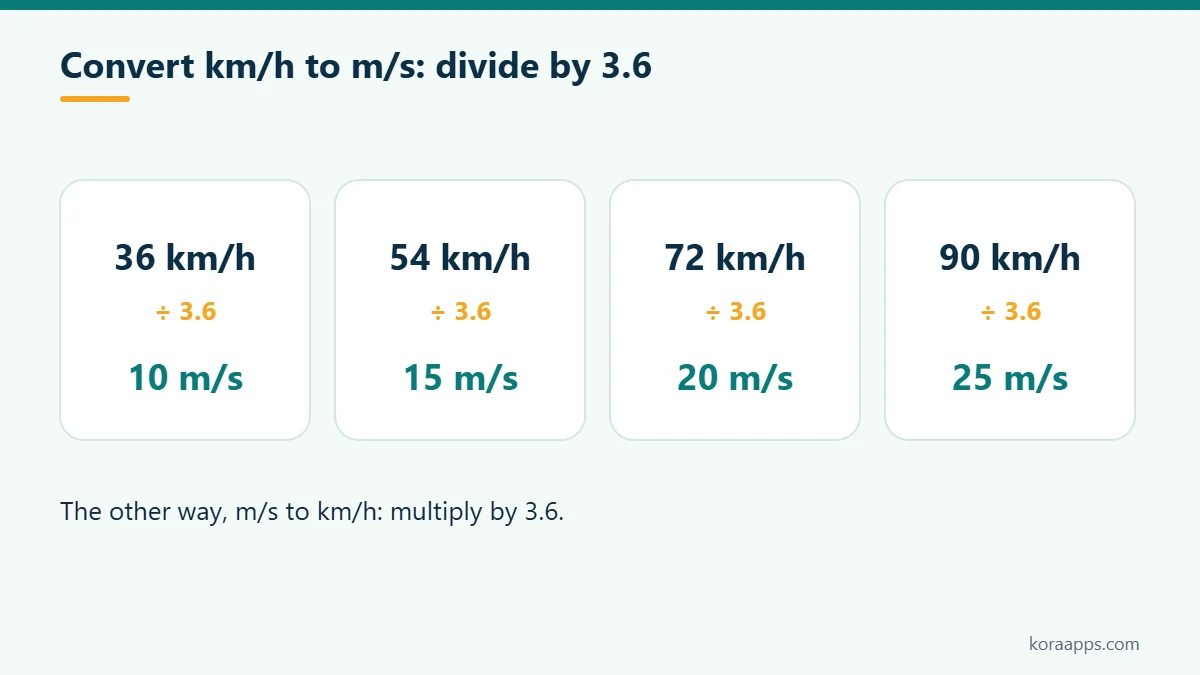
- Plugging km/h directly into equations with acceleration in m/s².
- Forgetting the negative sign of a when the object slows down or brakes.
- Using s = v·t from uniform motion for accelerated motion.
- Confusing distance and position when the object reverses direction.
Check your work with an app
In Giải Nhanh, Physics → Kinematics includes Velocity under uniform acceleration (v = v₀ + at) and the Velocity–displacement relation (v² − v₀² = 2as). Enter three known values and the app finds the fourth with a step-by-step solution. For side calculations, see how to use a scientific calculator on your phone.
Conclusion
With constant acceleration problems, convert units to m/s, take the direction of motion as positive to fix the sign of a, then pick the equation that leaves out the quantity the problem does not give. If the problem has a v–t graph, read acceleration from the slope and displacement from the area; if it asks for distance without giving time, go straight to v² − v₀² = 2as.
Frequently asked questions
Does negative acceleration always mean slowing down?
No. An object slows down when a and v have opposite signs. If it moves in the negative direction (v < 0) and a < 0, it is speeding up.
Which equation does not need time?
v² − v₀² = 2·a·s, used when a problem gives velocities and distance, or asks for one of them.
How do I convert 54 km/h to m/s?
Divide by 3.6: 54 / 3.6 = 15 m/s.
How do I find distance from a v–t graph?
It equals the area enclosed by the graph, the time axis and vertical lines at the start and end times.