
The free fall formula set has three core equations: velocity v = gt, distance h = ½gt² and the time-free relation v² = 2gh. Know any two of height, time and velocity and you can find the third. This guide summarizes every formula you need, explains when they apply, works through four problems and lists the mistakes that cost students marks.
What is free fall?
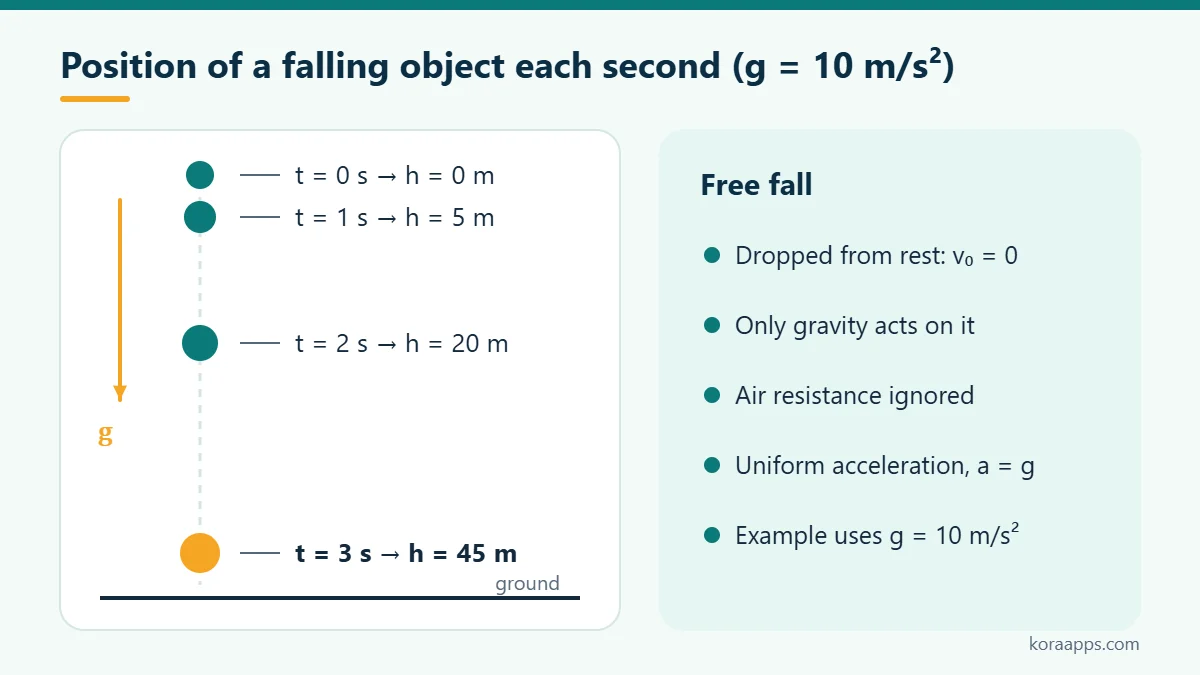
Free fall is the motion of an object acted on only by gravity, with air resistance ignored, starting from rest (initial velocity zero). It is straight-line motion with uniform acceleration, pointing straight down, with acceleration equal to the gravitational acceleration g.
Near Earth’s surface, g ≈ 9.8 m/s². Many textbook problems use g = 10 m/s² to keep the numbers simple, so always check which value the problem gives.
Free fall formula table
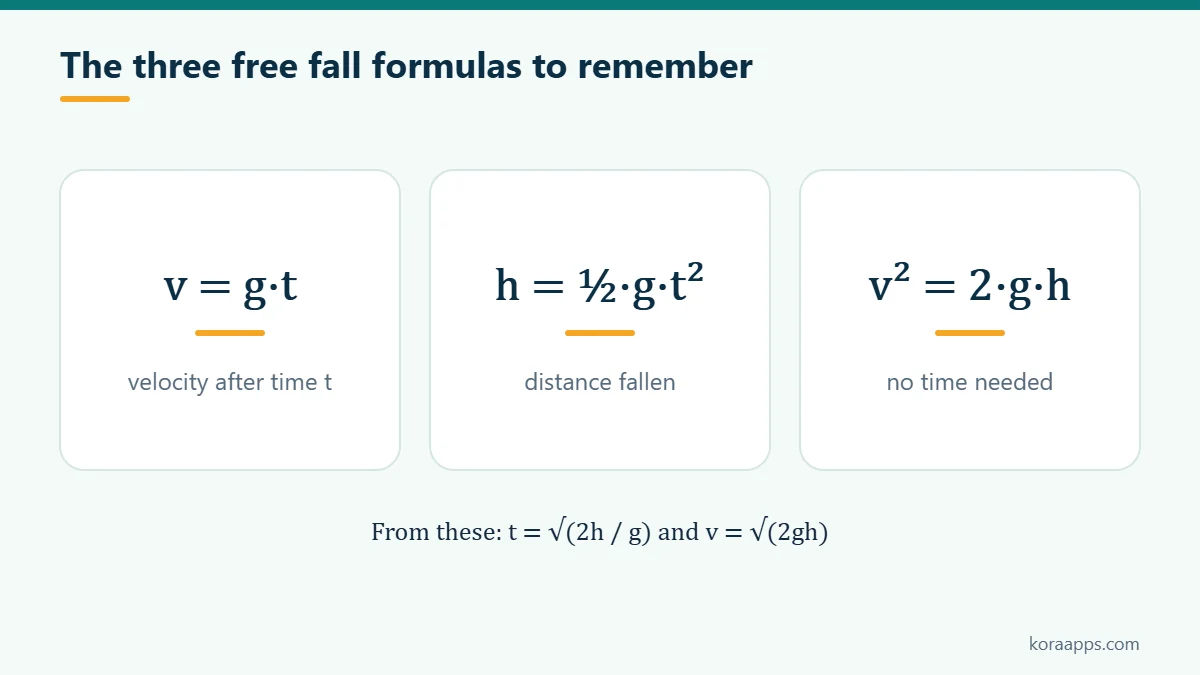
| To find | Formula | Unit |
|---|---|---|
| Velocity after time t | v = g · t | m/s |
| Distance (height) fallen | h = ½ · g · t² | m |
| Velocity–height relation | v² = 2 · g · h | — |
| Time to fall height h | t = √(2h / g) | s |
| Impact velocity from height h | v = √(2gh) | m/s |
| Distance fallen during the nth second | Δh = ½ · g · (2n − 1) | m |
The nth-second formula comes from subtracting the distance fallen after (n − 1) seconds from the distance fallen after n seconds.
Free fall problems with solutions
Problem 1: find the height from the fall time
An object is dropped and hits the ground after 3 s. Take g = 9.8 m/s². Find the drop height and the impact velocity.
- h = ½ × 9.8 × 3² = 0.5 × 9.8 × 9 = 44.1 m.
- v = g × t = 9.8 × 3 = 29.4 m/s.

Problem 2: find the fall time from the height
A stone is dropped from 20 m, with g = 10 m/s². How long until it hits the ground, and how fast is it moving then?
- t = √(2h / g) = √(2 × 20 / 10) = √4 = 2 s.
- v = g × t = 10 × 2 = 20 m/s (check: v² = 2gh = 400, so v = 20).
Problem 3: distance fallen in the 3rd second
An object falls freely with g = 10 m/s². How far does it fall during the third second?
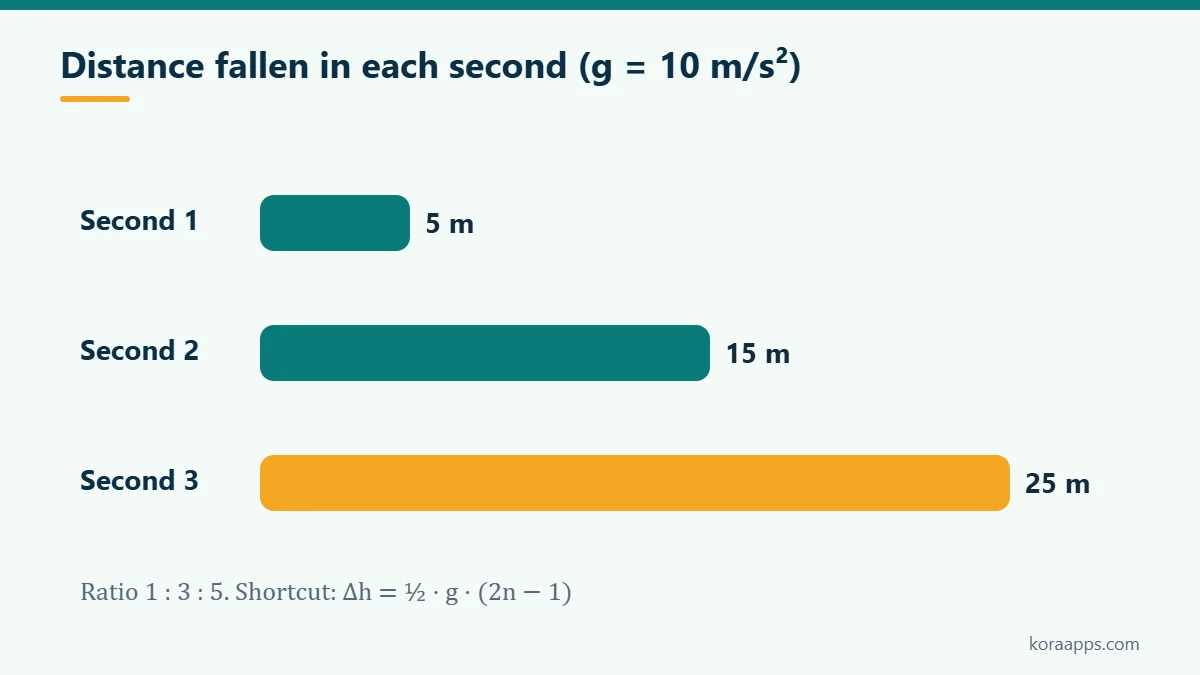
- After 3 s: h₃ = ½ × 10 × 3² = 45 m. After 2 s: h₂ = ½ × 10 × 2² = 20 m.
- Distance in the 3rd second: 45 − 20 = 25 m. With the shortcut: ½ × 10 × (2 × 3 − 1) = 25 m.
Problem 4: impact velocity from a given height
An object falls from 80 m with g = 10 m/s². Find its impact velocity.
- v = √(2gh) = √(2 × 10 × 80) = √1600 = 40 m/s.
- Fall time: t = v / g = 4 s.
Common mistakes in free fall problems
- Wrong g: the problem says g = 10 m/s² but you use 9.8, or the other way round.
- Applying it to a thrown object: if the object has an initial velocity v₀ ≠ 0, use h = v₀t + ½gt² and v = v₀ + gt; it is no longer free fall from rest.
- Forgetting to square t: writing h = ½gt instead of ½gt².
- Confusing “the nth second” with “the first n seconds”: the 3rd second is only the interval from 2 s to 3 s.
- Units: convert heights given in cm or km to meters first.
Check free fall problems on your phone
After solving by hand, you can check with Giải Nhanh: open Physics → Kinematics → Free fall: height (or velocity), enter the two known values, and the empty field is calculated with a five-step solution including units. The default g is 9.8 m/s²; change it to 10 if your problem says so. If you are still choosing tools, see which type of math solver app to use.
Conclusion
For free fall problems, remember v = gt, h = ½gt² and v² = 2gh, and check two conditions: the object starts from rest and air resistance is ignored. If the problem gives the height, start with t = √(2h/g); if it gives the time, use h = ½gt² directly. For objects thrown up or down, switch to the constant-acceleration equations with v₀.
Frequently asked questions
What is the acceleration due to gravity?
About 9.8 m/s² near Earth’s surface. Problems often round it to 10 m/s² when allowed.
Do heavier objects fall faster?
No, if air resistance is ignored. All objects in free fall at the same place have the same acceleration g, so they hit the ground at the same time from the same height.
Is an object thrown straight up in free fall?
While rising it has an initial velocity, so the simple free fall formulas do not apply. Only the fall from the highest point (where velocity is zero) can be treated as free fall.
How do I find the distance fallen in the last second?
Subtract the distance fallen in the first (t − 1) seconds from the distance fallen in the full time t.