
Knowing how to calculate moles is the foundation of almost every chemistry problem: whether you start from mass, gas volume or solution concentration, the first step is always converting to moles. This guide collects the formulas used in middle and high school, explains when to use each one and walks through five worked problems.
Formulas for calculating moles
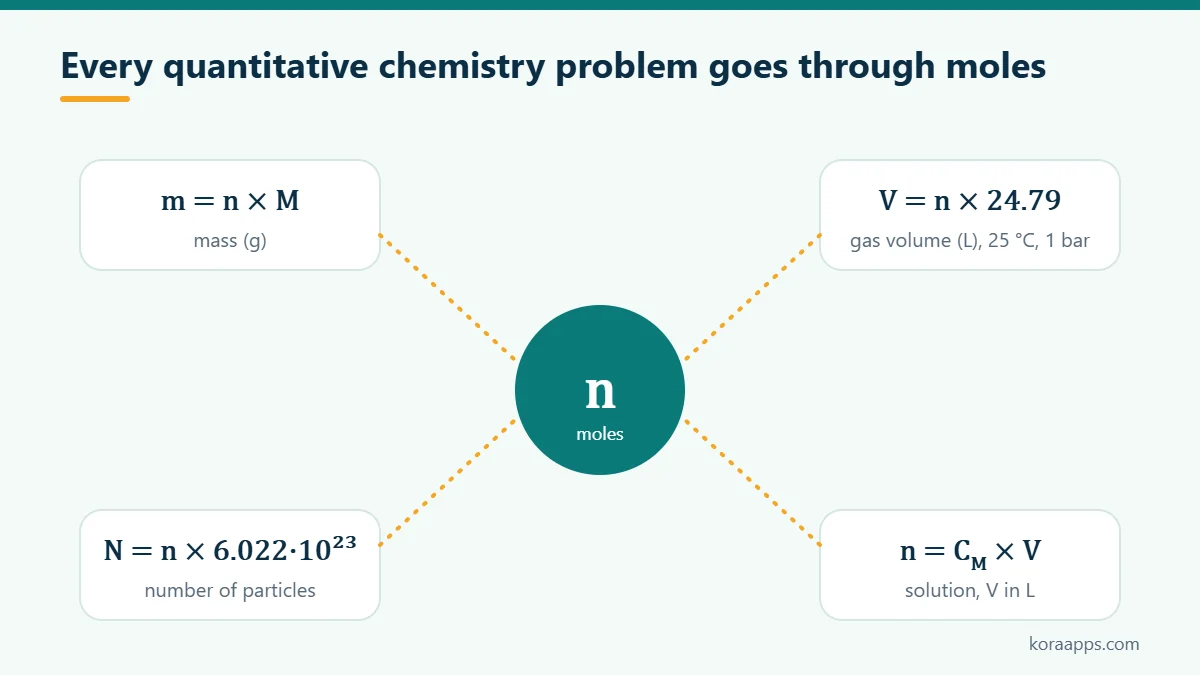
| Known quantity | Formula | Units |
|---|---|---|
| Mass m and molar mass M | n = m / M | m (g), M (g/mol) |
| Gas volume V at standard conditions (25 °C, 1 bar) | n = V / 24.79 | V (L) |
| Gas volume V at old STP (0 °C, 1 atm) | n = V / 22.4 | V (L) |
| Number of particles N | n = N / Nₐ, with Nₐ ≈ 6.022 × 10²³ | — |
| Molarity CM and solution volume V | n = CM × V | CM (mol/L), V (L) |
Many current textbooks, including Vietnam’s, use standard conditions of 25 °C and 1 bar with a molar gas volume of 24.79 L. Older problems still use STP at 0 °C and 1 atm with 22.4 L, so check whether the question says “standard conditions” or “STP”.
Solution concentration formulas
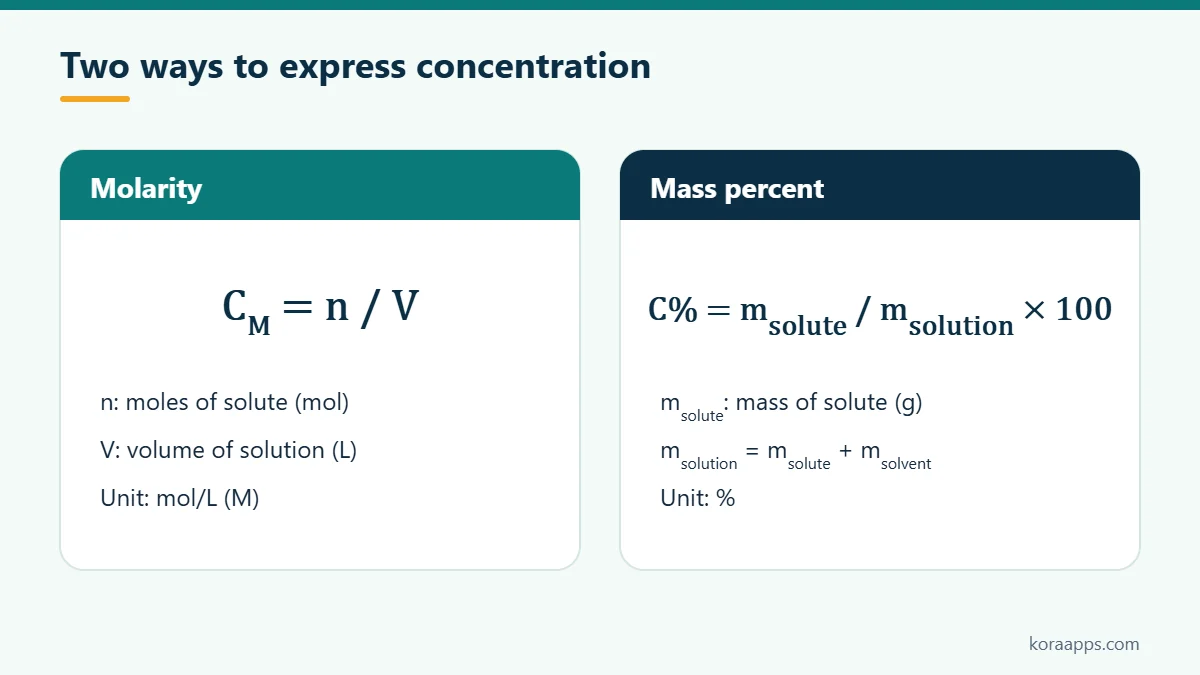
- Molarity: CM = n / V (mol/L, also written M).
- Mass percent: C% = msolute / msolution × 100%.
- Mass of solution: msolution = msolute + msolvent.
- From C% to CM: CM = 10 × D × C% / M, where D is density in g/mL.
- Dilution: C₁ × V₁ = C₂ × V₂ (moles of solute stay the same when water is added).
Worked problems on moles and concentration
Problem 1: moles from mass
Find the number of moles in 11.7 g of NaCl (M = 58.5 g/mol). Solution: n = 11.7 / 58.5 = 0.2 mol.
Problem 2: moles of gas from volume
Find the moles in 4.958 L of CO₂ at standard conditions. Solution: n = 4.958 / 24.79 = 0.2 mol. If the problem says 4.48 L at STP, n = 4.48 / 22.4 = 0.2 mol.
Problem 3: molarity
0.2 mol of NaCl is dissolved in water to make 500 mL of solution. Find CM. Solution: 500 mL = 0.5 L, so CM = 0.2 / 0.5 = 0.4 M.
Problem 4: mass percent
20 g of sugar is dissolved in 180 g of water. Find C%. Solution: msolution = 20 + 180 = 200 g, so C% = 20 / 200 × 100% = 10%. A common mistake is dividing by the 180 g of water instead of the 200 g of solution.
Problem 5: from mass percent to molarity
A 36.5% HCl solution has D = 1.19 g/mL. Find CM (M of HCl = 36.5 g/mol). Solution: CM = 10 × 1.19 × 36.5 / 36.5 = 11.9 M.
Dilution: how much water to add
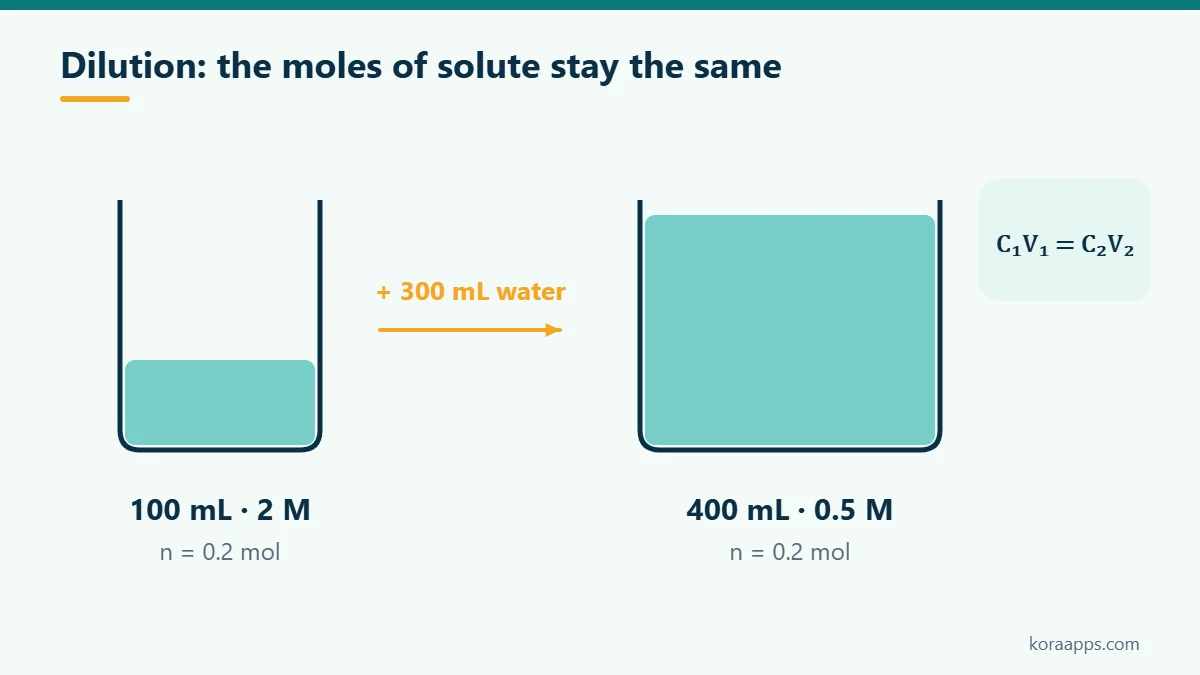
To dilute 100 mL of a 2 M solution to 0.5 M: V₂ = C₁V₁ / C₂ = 2 × 100 / 0.5 = 400 mL. So you add 400 − 100 = 300 mL of water. When diluting concentrated acid in real life, always add the acid slowly to the water, never the other way round.
Common mistakes when calculating moles
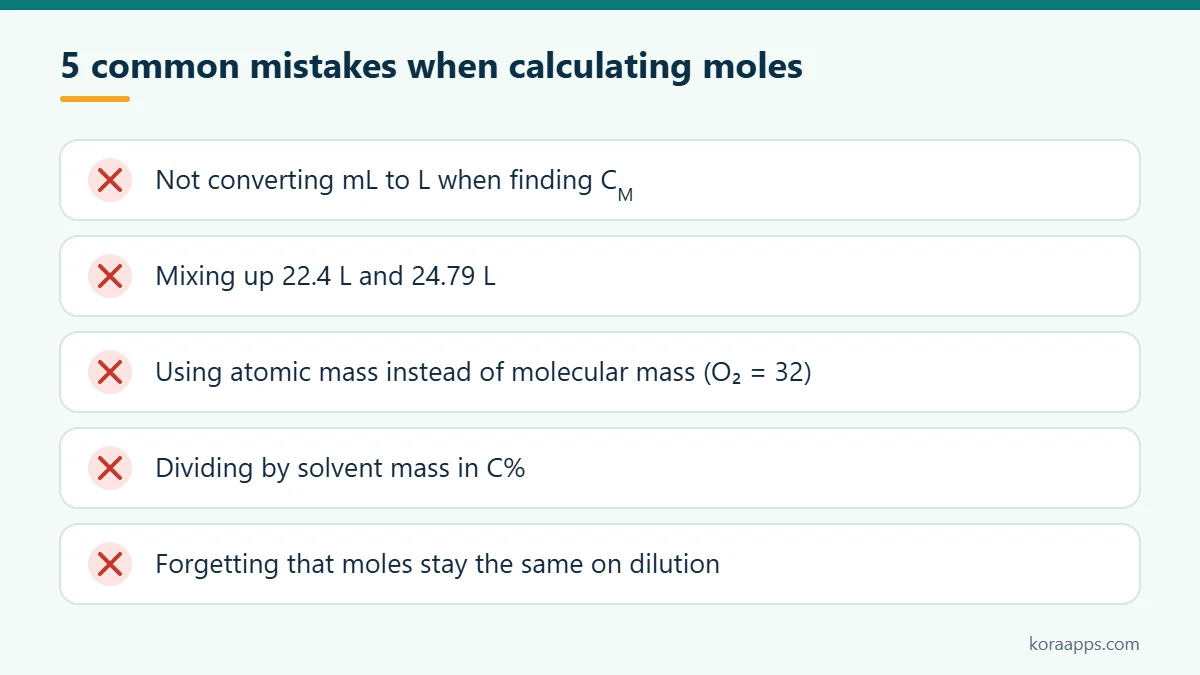
- Not converting mL to L before calculating CM.
- Using 22.4 L when the question says “standard conditions” (25 °C, 1 bar), or the other way round.
- Using atomic mass instead of molecular mass, for example M = 16 for O₂ gas instead of 32.
- Dividing by the mass of solvent instead of the mass of solution in C%.
- Forgetting that the moles of solute do not change on dilution.
Check your answers with an app
In Giải Nhanh, the Chemistry section has Amount of substance, Molar gas volume, Molar concentration, Mass percent concentration, the CM–C% relation and Dilution built in. Enter the known values and the empty field is calculated with a step-by-step solution including units. The molar gas volume formula notes both 24.79 L at standard conditions and 22.4 L at old STP so you can match your question. For side calculations, see how to use a scientific calculator on your phone.
Conclusion
In any quantitative chemistry problem, convert everything to moles first: divide mass by M, divide gas volume by the molar volume for the stated conditions, and multiply molarity by volume in liters for solutions. If the problem gives mass percent and density, convert to CM with 10 × D × C% / M before going further.
Frequently asked questions
Is the molar gas volume 22.4 L or 24.79 L?
Both, depending on conditions: 24.79 L at 25 °C and 1 bar (used in current textbooks), 22.4 L at the old STP of 0 °C and 1 atm.
How many particles are in one mole?
About 6.022 × 10²³ particles (Avogadro’s number), whether atoms, molecules or ions.
What does 0.5 M mean?
Each liter of solution contains 0.5 mol of solute.
Why convert mL to L when calculating molarity?
Because molarity is in mol/L. Using mL gives an answer 1,000 times too small.