
To solve quadratic equations of the form ax² + bx + c = 0 (a ≠ 0), you only need one formula and the three cases of the discriminant Δ. The tricky parts are sign errors, forgetting that a must not be zero, and missing the shortcuts that let you find roots in seconds. This guide goes from the quadratic formula to those shortcuts, with a fully worked example in each section.
The quadratic formula and the discriminant
For ax² + bx + c = 0, compute the discriminant Δ = b² − 4ac, then look at its sign:
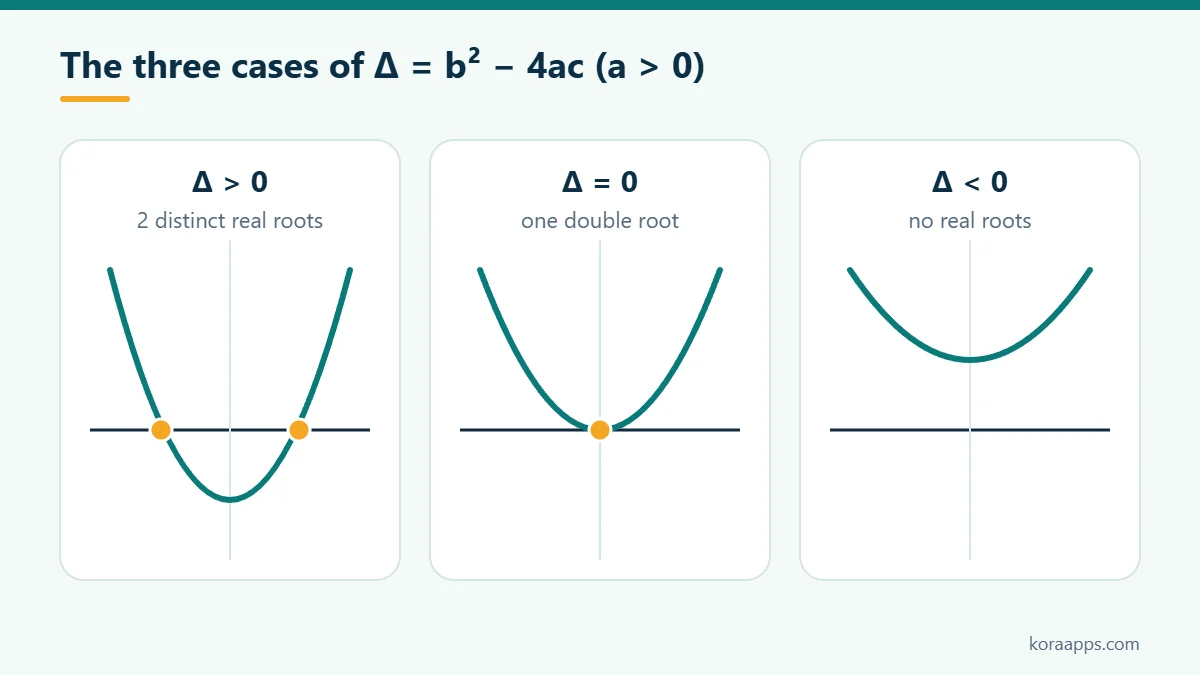
| Case | Conclusion | Roots |
|---|---|---|
| Δ > 0 | Two distinct real roots | x₁,₂ = (−b ± √Δ) / (2a) |
| Δ = 0 | One double root | x₁ = x₂ = −b / (2a) |
| Δ < 0 | No real roots | — |
Always check that a ≠ 0 before using the formula. If a = 0, the equation becomes linear, bx + c = 0, and needs a different approach.
Worked examples for all three cases
Δ > 0: solve 2x² − 7x + 3 = 0
- Coefficients: a = 2, b = −7, c = 3.
- Δ = (−7)² − 4 × 2 × 3 = 49 − 24 = 25 > 0, so √Δ = 5.
- x₁ = (7 + 5) / 4 = 3; x₂ = (7 − 5) / 4 = 0.5.
- Conclusion: two distinct roots, x = 3 and x = 0.5.

Δ = 0: solve x² − 4x + 4 = 0
Δ = (−4)² − 4 × 1 × 4 = 16 − 16 = 0, so there is one double root x = 4 / 2 = 2. The left side is actually (x − 2)², so spotting the perfect square is even faster.
Δ < 0: solve x² + x + 1 = 0
Δ = 1² − 4 × 1 × 1 = −3 < 0, so the equation has no real roots. When Δ is negative, do not try to take the square root: just state that there are no real solutions.
The reduced formula when b is even
If b = 2b′ (b is even), use Δ′ = b′² − ac to keep the numbers small. The roots are x₁,₂ = (−b′ ± √Δ′) / a.
Example x² − 6x + 5 = 0: b′ = −3, Δ′ = 9 − 5 = 4, √Δ′ = 2. So x₁ = 3 + 2 = 5 and x₂ = 3 − 2 = 1.
Shortcuts: find the roots without computing Δ
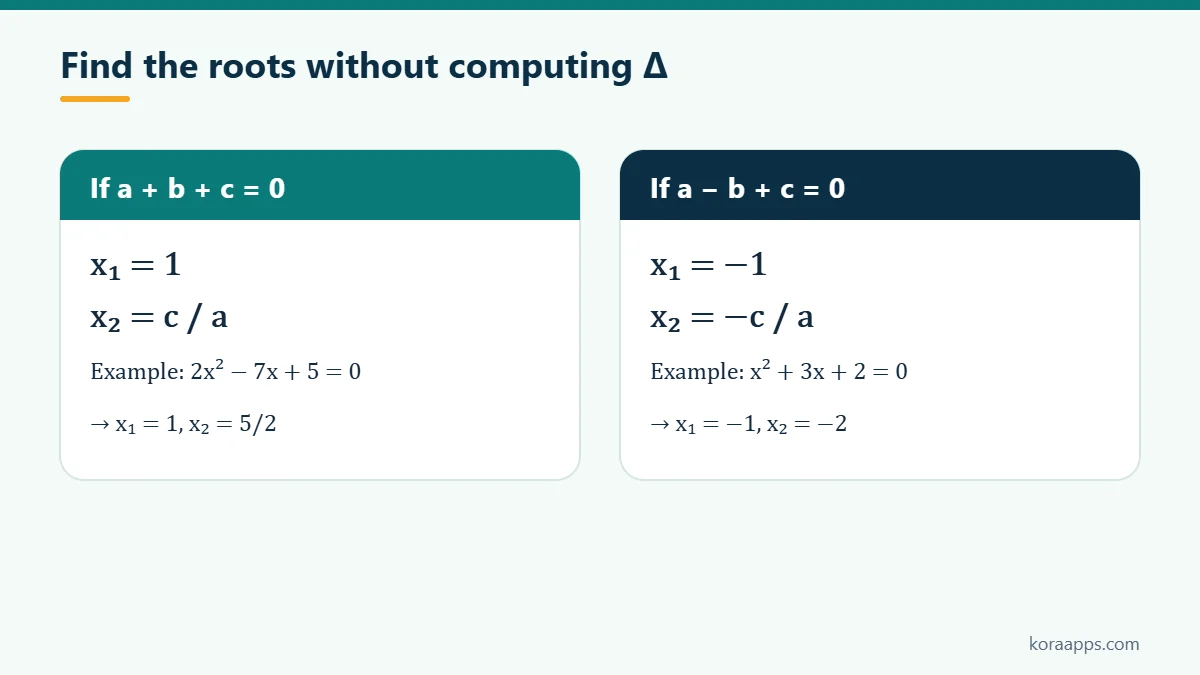
- a + b + c = 0: the roots are x₁ = 1 and x₂ = c / a. For 2x² − 7x + 5 = 0, 2 − 7 + 5 = 0, so x₁ = 1 and x₂ = 5/2.
- a − b + c = 0: the roots are x₁ = −1 and x₂ = −c / a. For x² + 3x + 2 = 0, 1 − 3 + 2 = 0, so x₁ = −1 and x₂ = −2.
These patterns show up often in multiple-choice tests. Checking them takes five seconds and can save a full minute.
Check your roots with Vieta’s formulas
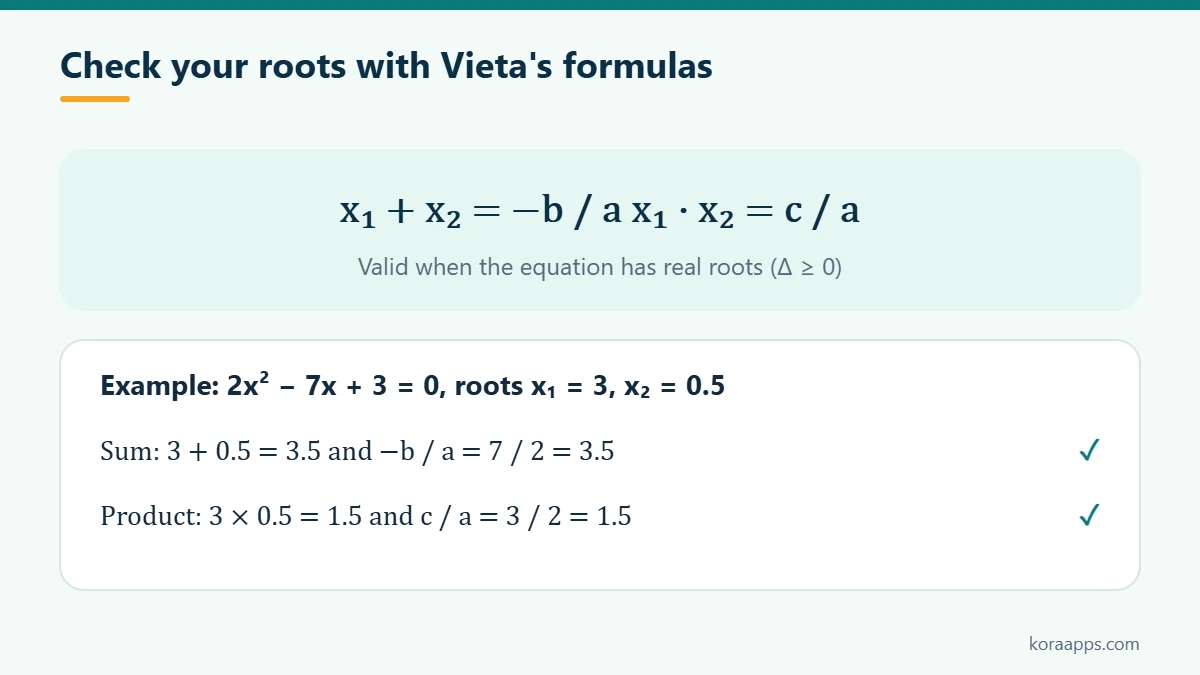
When real roots exist, their sum and product satisfy x₁ + x₂ = −b / a and x₁ · x₂ = c / a. For 2x² − 7x + 3 = 0: 3 + 0.5 = 3.5 = 7/2 and 3 × 0.5 = 1.5 = 3/2. Both match, so the roots are correct.
Common mistakes when solving quadratic equations
- Dropping the minus sign of b. With b = −7, −b = 7 and b² = 49.
- Dividing by a instead of 2a in the quadratic formula.
- Writing “no solution” for Δ < 0 when the task asks about complex roots (rare in high school, so read carefully).
- Reading off coefficients before rearranging the equation into ax² + bx + c = 0.
Solve quadratic equations on your phone
After solving by hand, you can check your work with Giải Nhanh: open Math → Quadratic equation and enter a, b and c. The app computes Δ, handles all three cases and shows a step-by-step solution like you would write on paper. For more tools, see 10 free study apps for students.
Conclusion
The fastest way to solve a quadratic equation is: rewrite it in standard form, try the a + b + c and a − b + c shortcuts, otherwise compute Δ (or Δ′ when b is even), and finally check with Vieta’s formulas. If you often make sign mistakes, write out each coefficient before substituting; once you are confident, lean on the shortcuts to save time.
Frequently asked questions
How many roots can a quadratic equation have?
At most two real roots. When Δ = 0 the two roots coincide as a double root.
When should I use Δ′ instead of Δ?
When b is even. Δ′ gives the same result as Δ with smaller numbers, so mental arithmetic is less error-prone.
What if a = 0?
Then the equation is linear, bx + c = 0, with solution x = −c / b if b ≠ 0.
How can I check my roots quickly?
Substitute them back into the equation, or compare their sum and product with −b/a and c/a using Vieta’s formulas.